The Enduring Utility of Manual Rivet Tools: A Product Deep Dive
Dec 01,2025
Manual rivet tools, often referred to as hand riveters or pop rivet guns, are essential, fundamental fastening instruments that have maintained their relevance in workshops, construction sites, and DIY garages despite the rise of powered alternatives. Characterized by their simplicity, portability, and dependability, these tools offer a cost-effective and accessible solution for securing two or more materials together using blind rivets.
Understanding the Mechanism
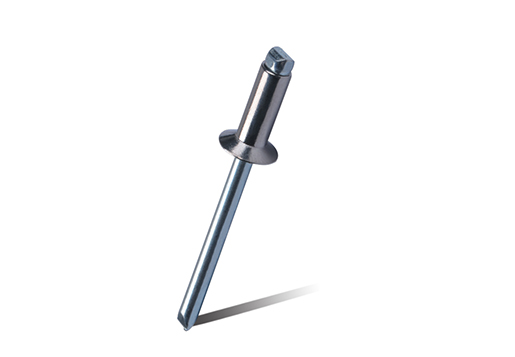
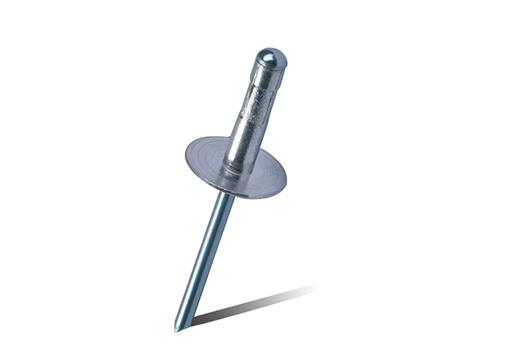
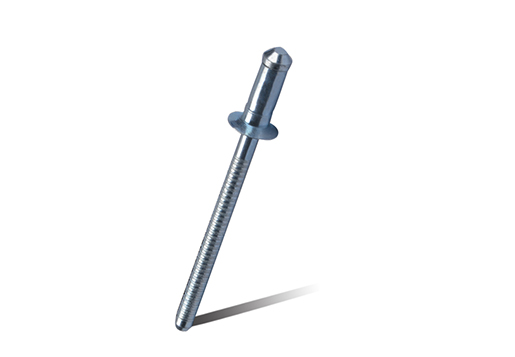
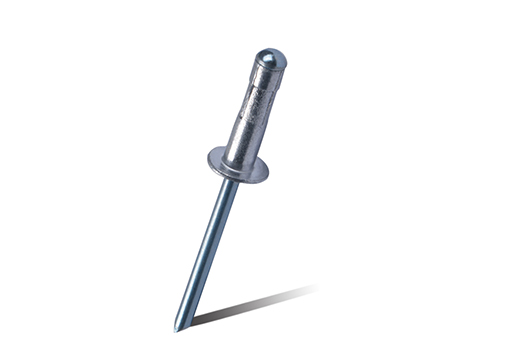
The function of a manual rivet tool is elegantly simple, relying purely on mechanical leverage to set a blind rivet. A blind rivet, or “pop rivet,” consists of two main parts: the rivet body (the sleeve) and the mandrel (the pin).
Insertion: The rivet’s mandrel is inserted into the tool’s nosepiece (or die), which must match the rivet’s diameter. The rivet body is then placed through a pre-drilled hole in the materials to be joined.
Actuation: The user squeezes the tool’s handles. This action engages the jaw assembly (a set of collets) inside the tool head.
Pulling and Deformation: The jaws grip the mandrel and pull it backward. As the mandrel is pulled through the rivet body, it forces the back-end of the body to expand, or “set,” forming a tight, secure bulb-like head against the blind side of the material.
Snap-Off: When the joint is fully secured and the material’s yield strength is overcome, the mandrel snaps off at a pre-designed breaking point, leaving a clean, finished rivet head.
The simplicity of this lever-based, hand-powered mechanism is the core of the manual tool’s appeal.
Key Product Variations and Features
Manual rivet tools come in several designs, each optimized for different applications, rivet sizes, and required power:
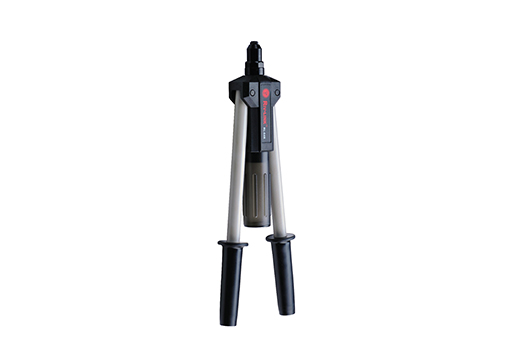
Standard Hand Rivet Gun (Plier Style):
Description: The most common and compact type, resembling a pair of heavy-duty pliers. It is operated one-handed or two-handed for small to medium-sized rivets (typically up to 5/32" or 4.0 mm).
Pros: Highly cost-effective, extremely portable, and easy to store.
Cons: Requires significant hand strength and can cause fatigue during prolonged or high-volume use. Mandrels must often be manually collected after installation.
Heavy-Duty Lever Riveter (Two-Handed/Long-Arm Riveter):
Description: Features long handles to maximize leverage, significantly reducing the physical effort required.
Pros: Better for setting larger diameter rivets (up to 3/16" or 4.8 mm, sometimes 1/4") or rivets made from harder materials like steel and stainless steel. The increased leverage allows for a smoother, less strenuous pull. Many models include a mandrel collector to catch the spent pins, improving safety and cleanliness.
Cons: Less compact and typically more expensive than the standard gun.
Lazy Tong Riveter (Scissor Riveter):
Description: Utilizes a collapsing “lazy tong” or scissor mechanism. The design provides a much greater mechanical advantage than simple levers, meaning less effort is needed over a longer stroke.
Pros: Excellent for repetitive work and setting larger rivets with minimal user fatigue. The extended action allows for deep-reach riveting.
Cons: Bulkiest of the manual options, making it less suitable for tight spaces.
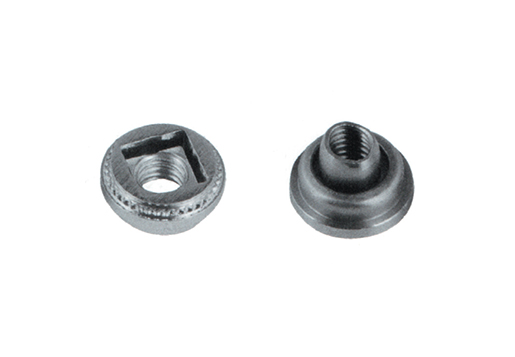
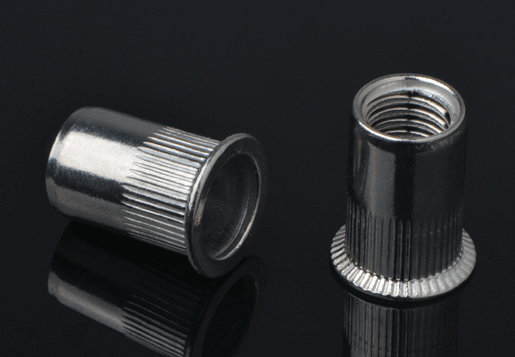
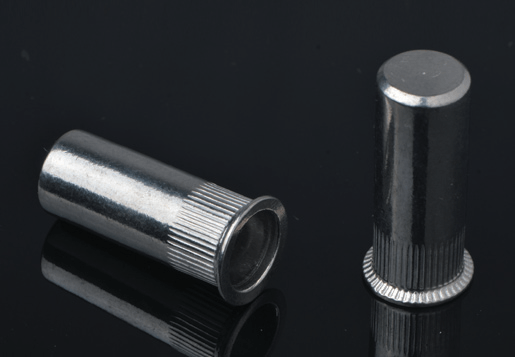
Description: A specialized manual tool designed to install rivet nuts (threaded inserts), not standard blind rivets. It uses a ratcheting motion to draw the nut into the material, creating load-bearing threads in thin material.
Pros: Creates a strong, reusable threaded fastening point where a tap or weld nut is impractical.
Cons: Used for a specific type of fastener (rivet nuts) and not for standard riveting.
Key Product Specifications
When assessing a manual rivet tool, several specifications dictate its capability and performance:
Rivet Capacity: This specifies the range of rivet diameters (e.g., 3/32", 1/8", 5/32", 3/16") and the maximum material hardness (e.g., aluminum, steel, stainless steel) the tool can reliably set.
Nosepieces (or Nozzle Heads): Tools are typically supplied with a set of interchangeable nosepieces to accommodate different rivet diameters. A system for easy changing and onboard storage for these pieces is a key convenience feature.
Body Material: High-quality tools feature a durable, often reinforced steel or alloy body and head, ensuring longevity under high load.
Grip/Ergonomics: Ergonomic rubber or vinyl grips are crucial for comfort and reducing hand strain, especially on standard squeeze-style guns.
Leverage Ratio: For long-arm riveters, a higher leverage ratio translates directly to less physical force required by the user.
Ideal Applications
Manual rivet tools are the optimal choice in numerous scenarios:
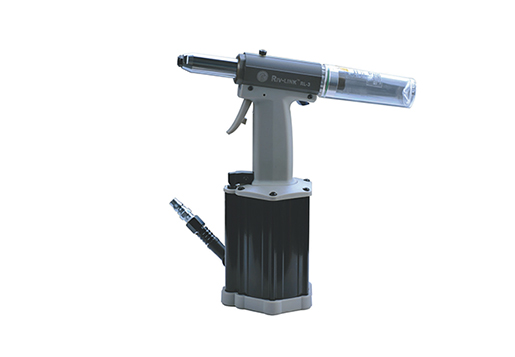
Small-Scale Projects and Repairs: Perfect for occasional use, quick fixes, and automotive, HVAC, or household repairs where only a few rivets need setting.
Portability and Mobility: Since they require no air compressor, battery, or power cord, they are unbeatable for on-site engineers, mobile technicians, and applications in remote locations.
Cost Efficiency: They represent the most economical entry point for riveting capabilities.
Precision Control: For delicate materials or critical applications, the tactile feedback of a manual tool allows the user to control the setting force precisely, minimizing the risk of over-tightening or damaging the workpiece.