We welcome you to contact us, STEADY not only your reliable supplier, but also your turstworthy business partner.
 +(86)-133 8863 9264
Apr 29,2026
Content
When people ask how many pounds a rivet nut can hold, the answer depends on which type of load you're talking about. Rivet nuts — also called nutserts, blind rivet nuts, or threaded inserts — can fail in three distinct ways, and each has its own strength rating. Understanding the difference is the first step to using rivet nuts correctly and safely.
Pull-out strength (also called tensile strength) is the force required to yank the rivet nut straight out of the base material in the axial direction — essentially pulling it through the hole. This is the most commonly referenced load rating because it's the most straightforward failure mode to test. Shear strength is the resistance to a lateral force applied perpendicular to the rivet nut's axis — the kind of load that tries to slide the fastener sideways through the material. Torque-out strength is the rotational resistance — how much turning force the installed rivet nut can handle before spinning in the hole. In most real-world applications, the actual load is a combination of all three, but pull-out strength is the primary benchmark used by manufacturers for load ratings.
The two biggest variables in rivet nut holding strength are thread size and the material the rivet nut itself is made from. Here's a practical breakdown of typical pull-out and shear strength figures you'll see across common rivet nut specifications. Note that these are representative values based on installation into 2–3 mm steel sheet — actual figures vary by manufacturer, base material, and installation quality.
| Thread Size | Steel Rivet Nut Pull-Out (lbs) | Aluminum Rivet Nut Pull-Out (lbs) | Stainless Steel Pull-Out (lbs) |
| M4 / #8-32 | 400 – 600 lbs | 200 – 350 lbs | 500 – 700 lbs |
| M5 / #10-24 | 600 – 900 lbs | 300 – 500 lbs | 700 – 1,000 lbs |
| M6 / 1/4-20 | 900 – 1,400 lbs | 450 – 700 lbs | 1,100 – 1,600 lbs |
| M8 / 5/16-18 | 1,400 – 2,200 lbs | 700 – 1,100 lbs | 1,800 – 2,600 lbs |
| M10 / 3/8-16 | 2,000 – 3,200 lbs | 1,000 – 1,600 lbs | 2,500 – 3,800 lbs |
| M12 / 1/2-13 | 2,800 – 4,500 lbs | 1,400 – 2,200 lbs | 3,500 – 5,200 lbs |
These figures represent the capacity of a single rivet nut installed into steel sheet of adequate thickness. Shear strength values typically run 60–80% of the pull-out figures for the same fastener. For safety-critical applications, always apply a safety factor of at least 3:1 to 4:1, meaning you should not load a fastener rated at 1,200 lbs to more than 300–400 lbs in service. Always refer to the specific manufacturer's data sheet for the exact product you're using, as construction quality and heat treatment vary between brands.
The load ratings above assume installation into steel sheet of adequate thickness for the rivet nut size. In reality, the thickness and strength of the base material you're installing into has an enormous effect on how much weight a rivet nut can actually hold — often more so than the rivet nut itself. A high-strength stainless steel rivet nut installed in thin aluminum sheet is only as strong as the aluminum allows it to be.
Every rivet nut has a specified grip range — the minimum and maximum sheet thickness it is designed to clamp. If the base material is thinner than the minimum grip range, the rivet nut will not form a proper bulge on the blind side, resulting in a loose, understrength installation that can pull out at a small fraction of its rated capacity. As a general rule, for M6 rivet nuts, you want at least 1.5 mm of steel or 2.0 mm of aluminum. For M8 and larger, 2.0–3.0 mm of steel is the practical minimum for full-strength installation. Using a rivet nut in material thinner than specified is one of the most common causes of early fastener failure in DIY and light fabrication work.
A rivet nut installed in mild steel sheet will hold significantly more than the same fastener installed in the same thickness of aluminum or plastic. The blind-side flange of the rivet nut bears against the back face of the sheet material — if that material is soft or brittle, it will deform or crack around the fastener before the rivet nut itself reaches its rated pull-out strength. When installing into aluminum, reduce your load expectations by 40–60% compared to equivalent steel installation. For composite panels, fiberglass, or thin plastic sheeting, rivet nuts are generally not the correct fastener choice for any significant structural load — threaded plates or backing plates should be used instead.
Not all rivet nuts have the same body geometry, and the body style directly affects both the pull-out strength and, critically, the torque-out resistance — how well the installed insert resists spinning when you tighten a bolt into it.
Standard round-body rivet nuts have a smooth cylindrical shank. They are the most common type and are straightforward to install. Their weakness is torque-out resistance — under high bolt tightening torque, a smooth round body can spin in the hole because there is no mechanical feature preventing rotation. This limits the safe bolt torque to relatively modest values and makes them less suitable for applications that require frequent bolt removal and reinstallation, where cumulative spinning can enlarge the hole over time.
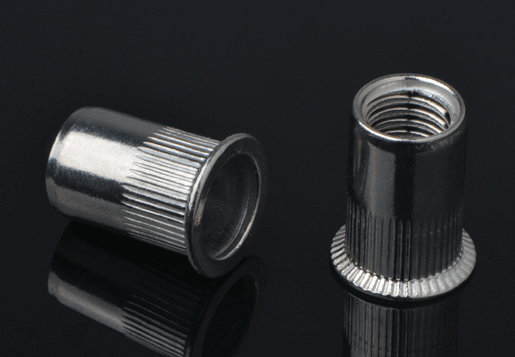
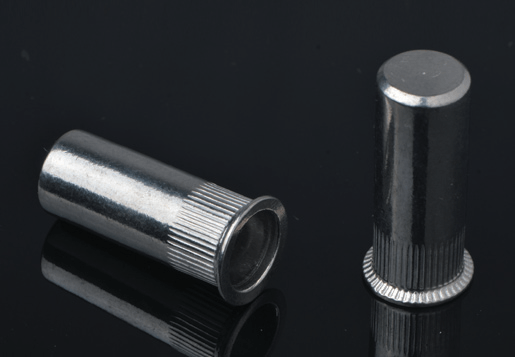
Knurled rivet nuts have a serrated or knurled outer surface on the shank. During installation, these serrations bite into the wall of the drilled hole and resist rotation far more effectively than a smooth body. Torque-out resistance on a knurled M8 rivet nut can be 3–5 times higher than the equivalent smooth-body design — often exceeding 30–50 Nm compared to 8–15 Nm for smooth body. For any application where you'll be regularly tightening and loosening bolts, or where high bolt preload is required, knurled body rivet nuts are the correct choice.
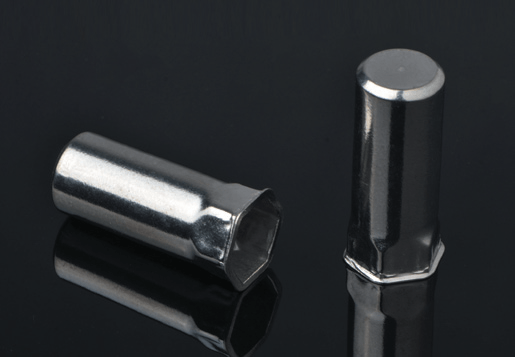
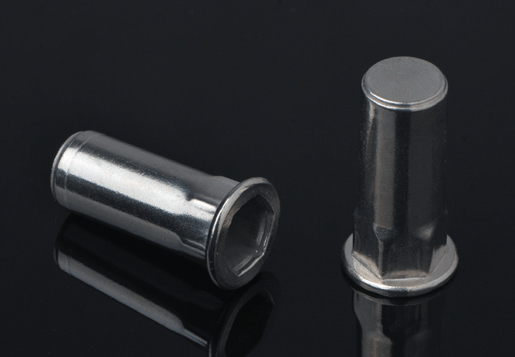
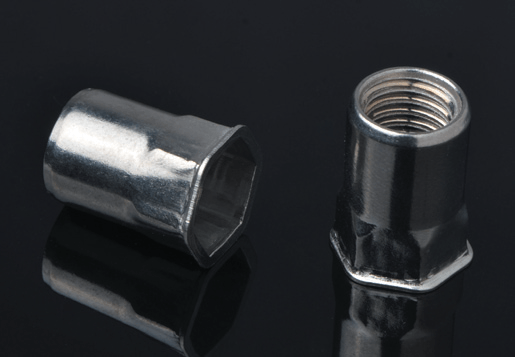
Hex body rivet nuts require a hexagonal hole (punched or broached rather than drilled) but deliver the highest torque-out resistance of any rivet nut type. The flat sides of the hex body lock mechanically against the sides of the hex hole, effectively preventing any rotation regardless of the bolt torque applied. They are the preferred choice in automotive and aerospace fabrication where fastener integrity under vibration and repeated assembly cycles is critical. The requirement for a hex hole is the main limitation — it adds a step to hole preparation that is not feasible in all applications.
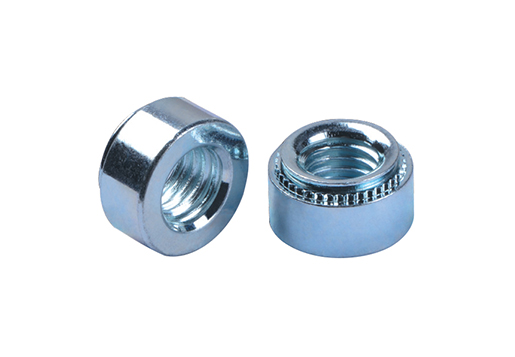
A rivet nut that has been correctly specified and is made from good-quality material can still fail well below its rated capacity if it is not installed properly. Poor installation is responsible for a significant proportion of rivet nut failures in the field, and most of these failures are entirely preventable.
Rivet nuts are available with several flange profile options, and the choice does affect both the load distribution and the practical load capacity in certain applications.
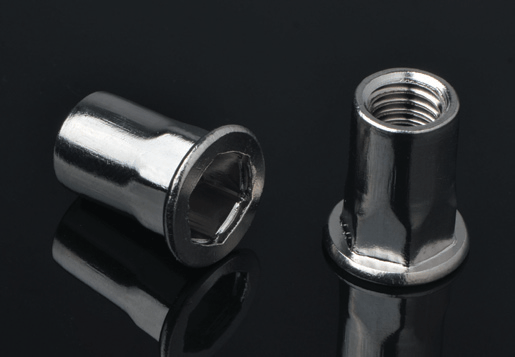
Standard flat-flange rivet nuts are the default for most applications — the flange sits flush against the surface of the sheet and distributes the load over a defined contact area. Large-flange rivet nuts have a significantly wider flange diameter, which spreads the pull-out load over a larger area of the sheet surface. This is particularly valuable in thin or soft materials — the larger flange prevents the rivet nut from pulling through the material at the flange edge, effectively increasing the pull-out strength in those substrates by 20–40% compared to a standard flange. If you're installing into aluminum sheet thinner than 2 mm, or into composite panels, specifying a large-flange rivet nut is a straightforward way to improve the load rating without changing the thread size or switching materials.
Countersunk (CSK) flange rivet nuts are designed for applications where the surface must be completely flush — no protruding flange. The trade-off is reduced pull-out resistance at the flange interface, since the countersunk geometry concentrates load at the edge of the countersink rather than distributing it across a flat bearing face. CSK rivet nuts are best used where surface profile is the priority and loads are moderate — they are not the right choice for maximum load capacity.
Putting the numbers in context helps calibrate expectations. Here are common real-world use cases and the load demands involved:
Rivet nuts are not the only way to add a threaded connection to sheet metal — and understanding how they compare to alternatives helps with choosing the right fastening method for the load involved.
| Fastener Type | Typical Pull-Out Strength (M8) | Torque-Out Resistance | Requires Access to Both Sides? | Best For |
| Rivet Nut (smooth) | 1,400 – 2,200 lbs | Low | No | General blind-side fastening |
| Rivet Nut (knurled) | 1,400 – 2,200 lbs | High | No | High-torque, repeated assembly |
| Weld Nut | 2,500 – 4,000+ lbs | Very High | Yes (welding access) | High-strength, permanent joints |
| Clip / Speed Nut | 200 – 600 lbs | Moderate | No | Light-duty, easy removal |
| Self-Clinching Nut | 2,000 – 3,500 lbs | Very High | Yes (press-in access) | Thin sheet, high load, production |
Rivet nuts occupy a practical middle ground — they deliver far more strength than clip nuts and are installable with no access to the blind side, making them the right tool for repairs, retrofits, and fabrications where drilling and setting from one side is the only option. Where both sides are accessible and loads are very high, weld nuts or self-clinching nuts will outperform rivet nuts. For most general-purpose sheet metal work, however, a properly installed steel rivet nut of the correct size is entirely adequate.
Generic strength tables are useful for ballpark planning, but for any application where load matters — vehicle modifications, equipment mounting, structural brackets — you should work from the specific manufacturer's data for the exact product you are using. Here's how to do that reliably:
Copyright © Steady Industrial Fasteners Co., Ltd. All Rights Reserved China Blind Rivet Nuts Manufacturers Self-Clinching Factory



 EN
EN  English
 русский
 한국어
한국어 عربى
عربى Türk
Türk