We welcome you to contact us, STEADY not only your reliable supplier, but also your turstworthy business partner.
 +(86)-133 8863 9264
Mar 18,2026
Content
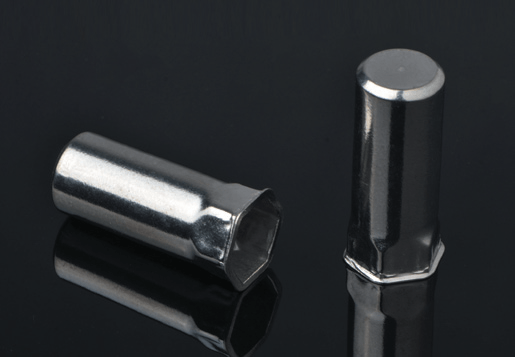
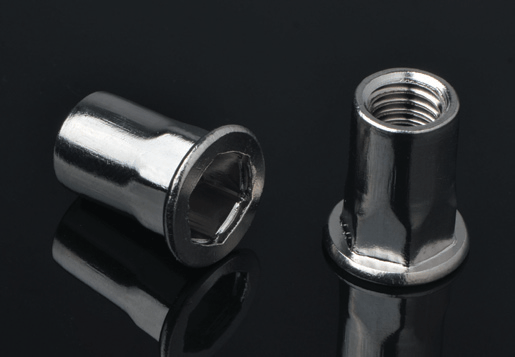
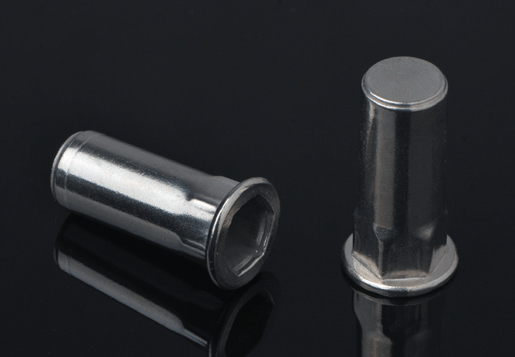
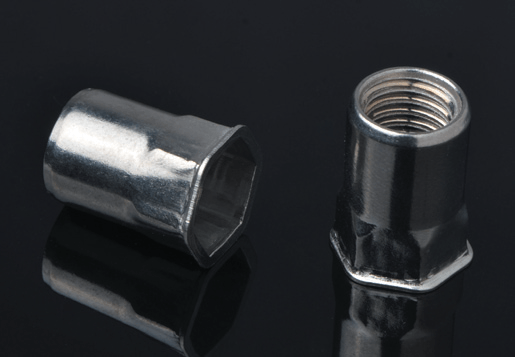
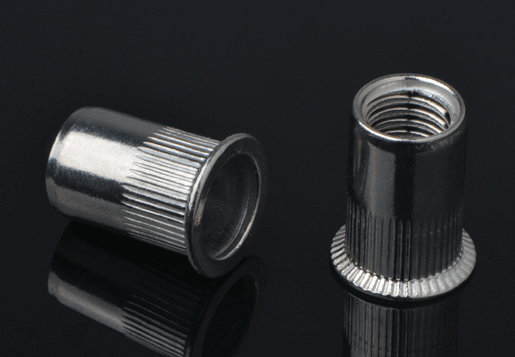
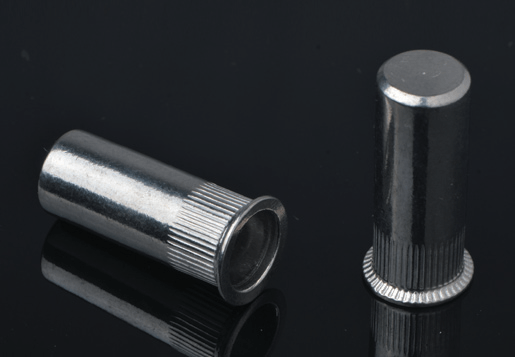
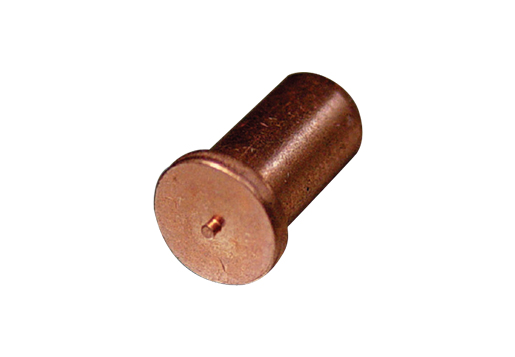
A flat head round body rivet nut — also commonly called a flat head round shank insert nut, blind rivet nut, or rivnut — is a type of threaded fastener designed to create a strong, reliable internal thread in thin or hollow materials where you can only access one side. The "flat head" refers to the low-profile flange that sits flush or nearly flush against the surface of the workpiece, while the "round body" describes the smooth, cylindrical shank that gets inserted into a pre-drilled hole and deformed on the blind side to lock the fastener in place.
Unlike hex body or knurled body rivet nuts, the round body design allows for smooth insertion and is best suited for applications where the hole tolerances are precise and spin-out is not a primary concern. The flat head profile keeps the installed fastener sitting low and clean against the surface, which is important in assemblies where aesthetics, mating surface contact, or clearance constraints are critical.
The installation principle of a flat head round shank rivet nut is straightforward but clever. The fastener is threaded onto a mandrel tool, then inserted into a pre-drilled hole in the base material. When the tool is actuated — either manually or pneumatically — it pulls the mandrel backward while the tool nose holds the flange against the surface. This action causes the lower portion of the round body to buckle outward, forming a bulge or "collar" on the blind side of the material. The result is a mechanically locked threaded insert that clamps around the material from both sides.
Once installed, the flat head round body blind rivet nut provides a permanent internal thread that can accept a matching bolt or screw repeatedly without damaging the base material. This makes it especially valuable in sheet metal, thin-walled tubing, fiberglass panels, and plastic components where cutting threads directly would be impractical or structurally weak.
Rivet nuts come in several head configurations, and choosing the right one matters for both function and fit. Here's how the flat head compares to other common styles:
| Head Style | Profile Height | Best Use Case |
| Flat Head (Low Profile) | Very low | Flush mounting, tight clearances, clean surface finish |
| Large Flange Head | Low but wide | Soft or thin materials needing wider load distribution |
| Countersunk Head | Flush (recessed) | Fully flush finish where no head protrusion is acceptable |
| Dome / Round Head | Higher profile | General use where surface protrusion is acceptable |
The flat head round body rivet nut strikes a balance between a minimal surface profile and ease of installation. It's the most commonly specified head style in automotive, electronics, and appliance manufacturing precisely because it keeps assemblies compact without requiring a countersunk hole preparation.
The body shape of a rivet nut plays a significant role in how it performs under torque loading. Understanding the trade-offs between round and hex body designs helps you make the right specification decision for your application.
The round body — also referred to as a round shank rivet nut — relies entirely on the radial compression of the deformed bulge to resist spin-out. In materials with consistent hole dimensions and adequate grip, this provides very good holding power. Round body inserts are easier and faster to install because they don't require the hole to be shaped or aligned with a specific orientation. They also produce a cleaner-looking installation since the body sits symmetrically inside the hole.
Hex body rivet nuts have a six-sided shank that bites into the edges of a hex-punched or drilled hole, providing mechanical resistance to rotation even before full deformation. This makes them better suited for high-torque applications or softer base materials like aluminum or plastics where a round body might spin under load. The trade-off is that hex body installation requires a precisely punched or broached hex hole, which adds to tooling complexity and cost.
For most standard steel and stainless sheet metal applications, the flat head round body rivet nut delivers sufficient anti-spin performance at a lower cost and with simpler tooling requirements. For heavy-duty or high-vibration environments, consider specifying a hex body or knurled body variant instead.
Flat head round body blind rivet nuts are manufactured in a range of materials to suit different environmental conditions, load requirements, and compatibility needs. Here are the most common options:
Common finishes applied to steel flat head round body rivet nuts include clear zinc, yellow zinc dichromate, black oxide, and nickel plating. For applications requiring RoHS compliance or exposure to salt spray beyond 200 hours, always confirm the specific finish specification with your supplier.
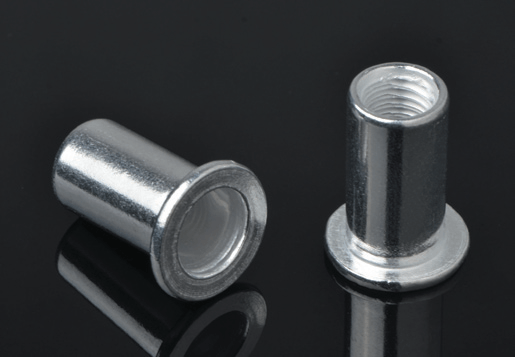
Flat head round body rivet nuts are available in metric and imperial thread sizes to accommodate both international and North American assembly standards. The most widely stocked metric sizes range from M3 through M12, while imperial sizes typically run from #6-32 through 3/8-16 UNC. The correct size selection depends on the bolt or screw being used, the grip range of the base material, and the required pull-out and torque-out load values.
| Thread Size | Hole Diameter (mm) | Typical Grip Range (mm) | Common Applications |
| M3 | 5.0 | 0.5 – 3.0 | Electronics, PCB housings, small enclosures |
| M4 | 6.0 | 0.5 – 3.5 | Appliances, lighting fixtures, HVAC panels |
| M5 | 7.0 | 0.5 – 4.0 | Automotive trim, cabinetry, industrial frames |
| M6 | 8.0 | 0.5 – 4.5 | Structural brackets, machine guards, trailers |
| M8 | 10.0 | 1.0 – 5.0 | Heavy equipment panels, bus bodywork, racking |
| M10 | 12.0 | 1.0 – 6.0 | Transport, construction machinery, marine |
Always match the grip range of the rivet nut to your actual material stack thickness. Installing a rivet nut in material thinner than the minimum grip range will result in incomplete deformation and poor holding strength. Installing in material thicker than the maximum grip range may prevent the bulge from forming at all.
Installing a flat head round body rivet nut correctly is straightforward when you follow the right process. Improper installation is the leading cause of fastener failure in service, so taking each step seriously pays off.
Use the hole diameter specified for your chosen rivet nut size (refer to the manufacturer's datasheet or the table above). An oversized hole will prevent proper grip and allow the rivet nut to spin. An undersized hole will prevent insertion entirely. Use a step drill or standard twist drill and deburr the hole before insertion.
Select the correct nose piece and mandrel for your thread size. Thread the rivet nut fully onto the mandrel so it seats securely, then back it off by one half-turn to allow free rotation during setting. Make sure the flat head flange is facing outward, toward the tool body.
Push the round body of the rivet nut fully into the pre-drilled hole until the flat head flange sits flat and flush against the material surface. Ensure there is no gap between the flange and the workpiece before actuating the tool.
Squeeze the handle (for manual tools) or trigger the pneumatic or battery-powered tool. The mandrel retracts, pulling the shank of the rivet nut toward the tool nose while the flat head holds firm against the surface. This causes the blind end of the round body to buckle and fold outward, forming the locking collar. Release the tool and unscrew the mandrel from the installed insert.
Check that the flat head sits flush with no tilt or gap. Try threading a bolt in by hand — it should engage smoothly with no wobble or resistance. If the nut spins freely in the hole, the installation has failed and the rivet nut must be drilled out and replaced.
The flat head round body rivet nut is specified across a broad range of industries precisely because of its versatile, clean installation profile. Here are the most common use cases where this specific fastener format excels:
Even experienced assemblers run into problems with rivet nuts when small details are overlooked. Here are the most frequent mistakes and how to avoid them:
Copyright © Steady Industrial Fasteners Co., Ltd. All Rights Reserved China Blind Rivet Nuts Manufacturers Self-Clinching Factory



 EN
EN  English
 русский
 한국어
한국어 عربى
عربى Türk
Türk